
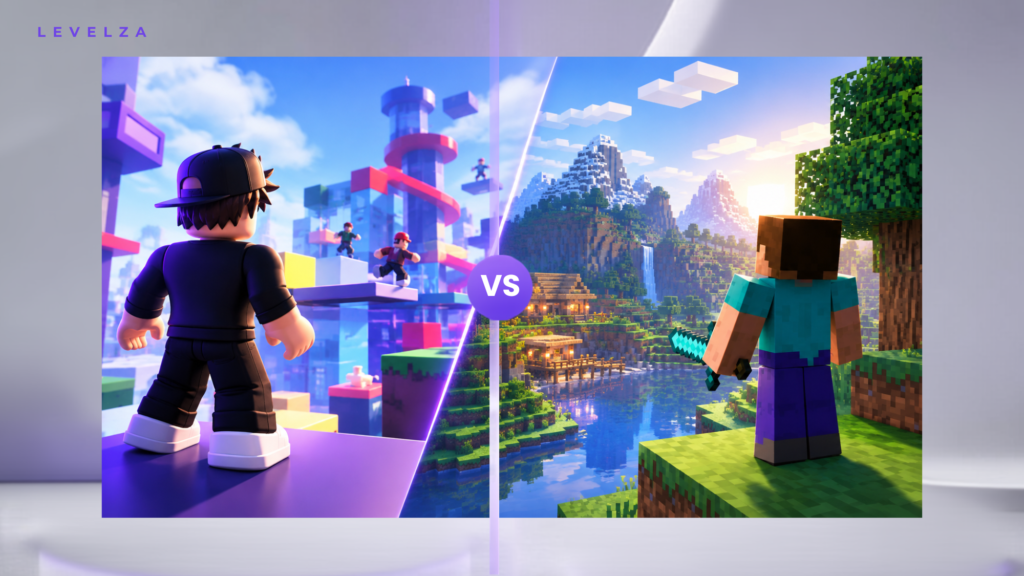

Roblox vs Minecraft comparisons get made constantly, usually because both titles share a blocky visual style and enormous popularity among younger players. That surface similarity hides two fundamentally different pieces of software with almost nothing in common under the hood.
Most online comparisons stop at graphics and general vibe, never unpacking the actual divide between a decentralized game engine platform and a standalone voxel survival simulator built by a single studio.
Roblox functions as a cloud-streamed distribution client hosting millions of discrete multiplayer worlds, each built independently by separate creators. Minecraft, by contrast, is a self-contained sandbox game with one unified ruleset centered on environmental manipulation and survival mechanics.
LEVELZA evaluated both gaming ecosystems across network architecture, creative asset pipelines, total cost of ownership, and player safety protocols to determine which platform fits your specific playstyle.
Roblox vs Minecraft: Head-to-Head Comparison Matrix
| Feature / Dimension | Roblox | Minecraft | LEVELZA Analysis & Verdict |
|---|---|---|---|
| Core Architecture & Engine | Distributed platform and cloud launcher running custom experiences via the proprietary Luau engine. | Standalone voxel-based sandbox game running on Java or Bedrock C++ codebases. | Minecraft Wins: Delivers a fully unified physical simulation and cohesive interactive ruleset compared to Roblox’s fragmented experiences. |
| Multiplayer Infrastructure | Fully centralized cloud servers; public matchmaking and private VIP server rentals via Robux. | Decentralized; supports LAN, private Realms subscriptions, or self-hosted external dedicated servers. | Tie / Situational: Roblox offers effortless one-click matchmaking with friends; Minecraft grants complete ownership and administrative control over dedicated servers. |
| Creative & Development Tools | Full professional game development suite (Roblox Studio) compiling 3D models, physics, and Lua scripts. | In-game block-by-block construction, Redstone mechanical logic gates, and command-block scripting. | Roblox Wins: Roblox Studio is a legitimate entry point into commercial game engineering; Minecraft focuses on creative architectural immersion. |
| Modding & Customization | Locked ecosystem; external client modding strictly prohibited by Byfron anti-cheat enforcement. | Extensive open-source modding API (Java Edition Forge/Fabric) alongside official Bedrock Add-Ons. | Minecraft Wins: Unrivaled community modification ecosystem enabling total overhauls of game mechanics, shaders, and terrain generation. |
| Monetization & Economy | Free-to-play with aggressive microtransactions (Robux), developer game passes, and cosmetic loot loops. | Fixed upfront premium purchase (with optional Bedrock Marketplace cosmetics/Realms subscriptions). | Minecraft Wins: Superior consumer value over time with zero pay-to-win mechanics or predatory currency friction in standard gameplay. |
| Safety & Moderation | Centralized machine-filtered chat, account age gating, and PIN parental restrictions across all servers. | Player-managed server moderation; Bedrock automated chat safety; private offline play completely isolated. | Minecraft Wins for Offline / Roblox Wins for Centralized Monitoring: Minecraft offline mode guarantees complete isolation; Roblox provides active reporting tools across public servers. |
Core Mechanics & Feature Differences
Platform vs. Product. Roblox is not a game — it’s a digital distribution service, comparable in structure to Steam or an app storefront, where every experience operates on independent rules, physics models, and camera perspectives set by its individual creator. Minecraft is the opposite: a single authored piece of software with fixed universal rules governing gravity, health, hunger, crafting recipes, and block placement that apply identically no matter which world is loaded.
That structural difference changes what “playing” even means on each platform. Loading into one Roblox experience tells you almost nothing about what the next one will feel like — an obstacle course and a tycoon simulator built by different developers can share nothing beyond the underlying client. Minecraft’s consistency means a player’s accumulated knowledge of crafting, combat, and world mechanics carries forward into every new world without relearning core systems.
The Creative Pipeline. Building inside Minecraft happens in real time, inside the active 3D world, using the avatar itself to place individual blocks one at a time. Developing for Roblox is a categorically different process: it requires launching an external desktop IDE (Roblox Studio), modeling meshes, writing Luau scripts, and debugging client-server replication — a workflow closer to professional software engineering than in-world construction.
This means the ceiling for creative output differs sharply between the two. Minecraft’s building ceiling is architectural and mechanical, bounded by what can be assembled from blocks and Redstone logic. Roblox’s ceiling is limited only by scripting ability, since Luau can drive entirely custom gameplay systems that have no equivalent inside Minecraft’s fixed rule set.
Single-Player and Offline Capability. Minecraft supports fully offline local world creation with no active internet connection required at any point. Roblox’s client cannot function this way — every session, including single-player exploration inside a public experience, depends on a persistent cloud handshake with Roblox’s servers. A dropped connection on Roblox ends the session outright; a dropped connection on Minecraft (in offline single-player) changes nothing at all.
PRO TIP
Parents evaluating internet-independent playtime — long flights, areas with unreliable connectivity, or households limiting online exposure — should weigh Minecraft’s offline single-player mode as a structural advantage, not just a feature checkbox. Roblox has no equivalent offline fallback.
Platform Availability & Cross-Progression
Both platforms support lightweight mobile and desktop clients alongside console releases, though the underlying account structures differ substantially.
Roblox maintains a single unified account across every device. Inventory, Robux balances, and friends lists transition automatically across PC, Mac, mobile, VR, and PlayStation/Xbox consoles, with no separate purchase or edition to manage.
Minecraft splits its ecosystem into two distinct editions. Minecraft: Java Edition runs on Windows, macOS, and Linux, with full modding support and PC-only server interoperability. Minecraft: Bedrock Edition spans consoles, mobile, and Windows, with cross-play enabled through a linked Microsoft account. The two editions do not share worlds or multiplayer servers directly, meaning a player’s choice between them early on has lasting consequences for who they can play with.
TECHNICAL WARNING
Players buying Minecraft for a specific console or device should confirm which edition that platform runs before assuming cross-play with friends. Java and Bedrock communities remain functionally separate outside of manual world conversion tools.
Pricing & Licensing Comparison
The Free-to-Play Economy of Roblox. The zero-dollar entry barrier conceals real lifetime monetization pressure. Developer-monetized Game Passes, consumable perks, VIP server rentals, and marketplace avatar dressing all draw on Robux, a currency purchased with real money in fixed-price bundles. None of these purchases are required to access core gameplay, but the loop is engineered to encourage repeated small purchases over time.
The Upfront Model of Minecraft. A single one-time purchase grants lifetime access to the relevant edition on the platform it was bought for, encompassing infinite procedurally generated worlds, free community skins, and tens of thousands of community-built mods with no ongoing subscription requirement. Optional costs exist — Bedrock Marketplace cosmetics and Realms server subscriptions — but neither is necessary to experience the full base game indefinitely.
For household budgeting, the practical difference is predictability. Roblox’s free entry point can still generate unexpected recurring charges if account spending controls aren’t configured. Minecraft’s upfront cost is the entire predictable expense in most cases, with no ongoing charge required to keep playing.